 EN
EN

Foundational Datum Systems for Reliable Lock Hole Positioning Accuracy
Precision in lock hole placement begins with establishing immutable reference points that withstand production demands. Without a robust datum framework, even advanced routers cannot compensate for inconsistent workpiece registration—a primary failure point in achieving ±0.05 mm lock hole positioning accuracy across door hardware batches.
Primary datum establishment using locating pins and dowel holes
Dowel holes placed at key points along with hardened locating pins establish what machinists call the main reference plane—the fixed starting point for everything else. When set to within 0.01 mm accuracy, these components stop parts from shifting when loaded into fixtures. Tests on airplane manufacturing setups showed this approach cuts down on error accumulation by around three quarters versus traditional edge referencing methods. The result? Drill holes for hardware stay consistently aligned even after making thousands of identical door frames without drifting off spec.
3-2-1 workpiece alignment to eliminate degrees of freedom without over-constraint
The 3-2-1 setup works like this: three contact points on the main surface, two on the secondary area, and just one point on the tertiary side. This arrangement holds door frames securely without causing those annoying stress marks that can warp materials over time. Basically, it locks down all six possible movement directions while still letting materials expand naturally as they should. When someone goes overboard with jig constraints, we start seeing problems. The metal starts to bend more than 0.1 mm when tightened down, which messes up where the locks need to go. Getting the 3-2-1 right means each door will have exactly the same space relationship between the router tool and the actual lock hole position. That's why shops that get this technique down pat can produce hundreds of doors with consistent quality using templates instead of guesswork.
Fixture Design Strategies That Sustain Lock Hole Positioning Accuracy at Scale
Modular, Low-Tolerance-Stack Jigs for Consistent Door Frame Registration
When making sure lock holes line up correctly across different production runs, modular jigs that minimize tolerance buildup become really important. The best ones use standard parts so positioning stays consistent within about 0.1 mm accuracy. Traditional solid jigs just don't cut it anymore because they take forever to adjust when switching between different door frames. What works well is getting rid of extra locating points since every additional contact point can cause small dimensional issues over time. We've found that applying kinematic coupling concepts cuts down on tolerance stacking problems by roughly two thirds compared to older methods. This makes a big difference in how consistently mortise locks and strike plates fit together during assembly.
Clamping Force Optimization to Prevent Workpiece Deflection During Lock Hole Routing
Getting the right amount of clamping force is really important to stop things from bending when making those lock holes, especially on thinner door frames where there's less material to work with. If we apply too much pressure, the wood might bend temporarily more than 0.2 mm which isn't good. But if the force isn't enough, the pieces can slip around while working on them. Finding that sweet spot means considering what different materials can handle before they give way (like around 15 to 20 Newtons per square centimeter for MDF cores), how vibrations affect everything, and how tools actually interact with the material. When pressure gets distributed properly across the work area, particularly around where the lock will go, it keeps everything stable so the router doesn't wander off track. According to shop floor reports, using these optimized force settings cuts down on misaligned holes by about three quarters in mass production environments, helping manufacturers hit their tight tolerance requirements of plus or minus 0.05 mm consistently.
System Calibration Protocols Critical to ±0.05 mm Lock Hole Positioning Accuracy
Axis compensation and geometric error mapping for router motion fidelity
Getting those precision copy routers calibrated properly is essential if we want to hit that lock hole positioning accuracy within plus or minus 0.05 mm. When these machines run for long periods, they tend to heat up, so thermal compensation algorithms kick in to fight against spindle expansion. Meanwhile, adjusting the backlash in those linear guides helps prevent any unwanted positional drift over time. There's also something called geometric error mapping involved here. Basically, it measures how much pitch, yaw and roll deviate throughout the entire working area, which allows software to fix those non-Cartesian distortions that creep in. We check everything using laser interferometers about every 500 operating hours to keep motion paths accurate down to under 0.01 mm per meter. This regular maintenance makes sure all those holes drilled in door frames come out consistently right batch after batch.
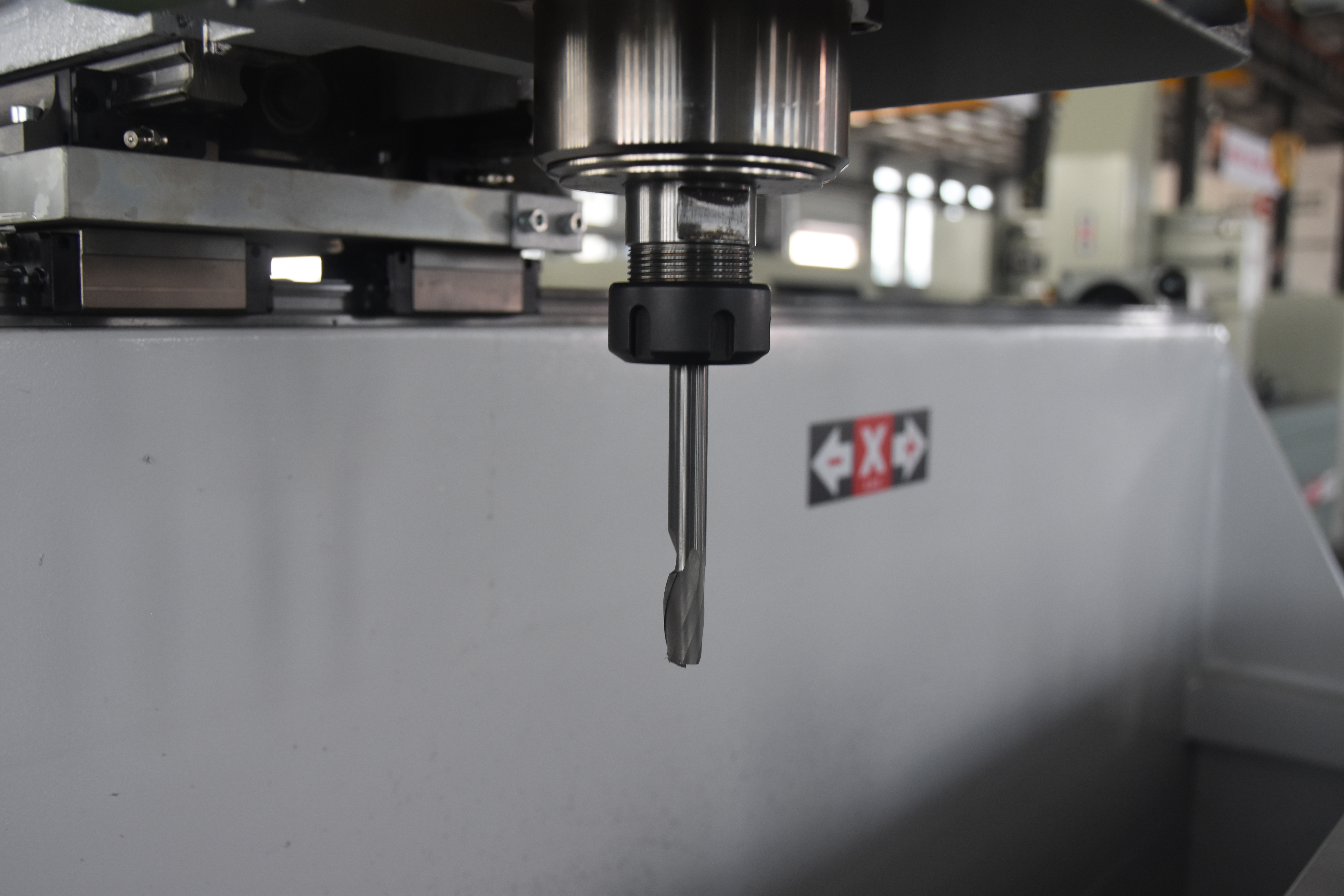
Spindle runout verification (<0.01 mm) and its direct effect on lock cutout repeatability
The condition of the spindle really affects how good those final lock cutouts turn out. To check things properly, manufacturers typically perform dynamic runout tests while the machine is running at normal speeds, often using capacitance probes for measurement. They also inspect the taper collets looking for tiny concentricity issues measured in microns. Another important step involves harmonic analysis which can spot early signs of bearing wear before any deflection goes beyond 0.005 mm. Some research from aerospace manufacturing shows that keeping runout below 0.01 mm actually cuts down on tool chatter by around 70%, which helps prevent those annoying oval-shaped lock holes. When paired with vacuum workholding systems that dampen vibrations during operation, this approach maintains pretty consistent routing precision across templates, even when spinning at impressive speeds like 18,000 RPM.
Verification and Validation Methods for Ongoing Lock Hole Positioning Accuracy
Keeping lock hole positions within a tight ±0.05 mm range demands several verification steps throughout the manufacturing process. For straight line measurements, laser interferometers are still considered gold standard equipment. These advanced systems can now detect differences as small as 0.001 mm thanks to their wavelength compensation features. When it comes to checking how well machines handle curved paths, ballbar tests come into play during actual production. They show where there might be problems with machine movement or servos getting out of sync. After parts are made, coordinate measuring machines (CMMs) check exactly where those holes ended up. The best ones account for temperature changes and meet strict NIST standards from 2023, keeping error margins below ±0.0035 mm. Manufacturers also watch statistical process control (SPC) charts closely. These charts track any shifts in position over time so adjustments can happen before anything goes outside acceptable limits. Optical scanners have become increasingly popular too. They scan parts instantly, looking at edges and comparing them directly to digital designs. Every six months, companies run gage R&R studies on their measurement tools. This helps ensure all the instruments stay consistent, which is crucial for maintaining those precise lock cutouts batch after batch.
FAQ Section
What is datum establishment and why is it important in manufacturing?
Datum establishment involves setting fixed reference points that orient and stabilize each part during manufacturing. It's crucial for maintaining accuracy in operations like lock hole positioning, preventing parts from shifting inconsistently during processes.
How does the 3-2-1 alignment technique enhance workpiece stability?
The 3-2-1 alignment technique secures workpieces by restricting movements across six directions without overly constraining materials. This ensures parts retain position while adapting naturally, crucial for consistent production quality.
What role do modular jigs play in lock hole positioning accuracy?
Modular jigs minimize tolerance stack-ups during production runs by utilizing standardized components. This method reduces potential dimensional errors over time, crucial for consistent lock hole alignment across batches.
How is spindle runout relevant to lock cutout precision?
Spindle runout affects the tool's precision and repeatability during machining. Minimal runout reduces tool chatter, ensuring oval-shaped holes are avoided, thus maintaining consistent lock cutout precision.
Table of Contents
- Foundational Datum Systems for Reliable Lock Hole Positioning Accuracy
- Fixture Design Strategies That Sustain Lock Hole Positioning Accuracy at Scale
- System Calibration Protocols Critical to ±0.05 mm Lock Hole Positioning Accuracy
- Verification and Validation Methods for Ongoing Lock Hole Positioning Accuracy
- FAQ Section