 EN
EN

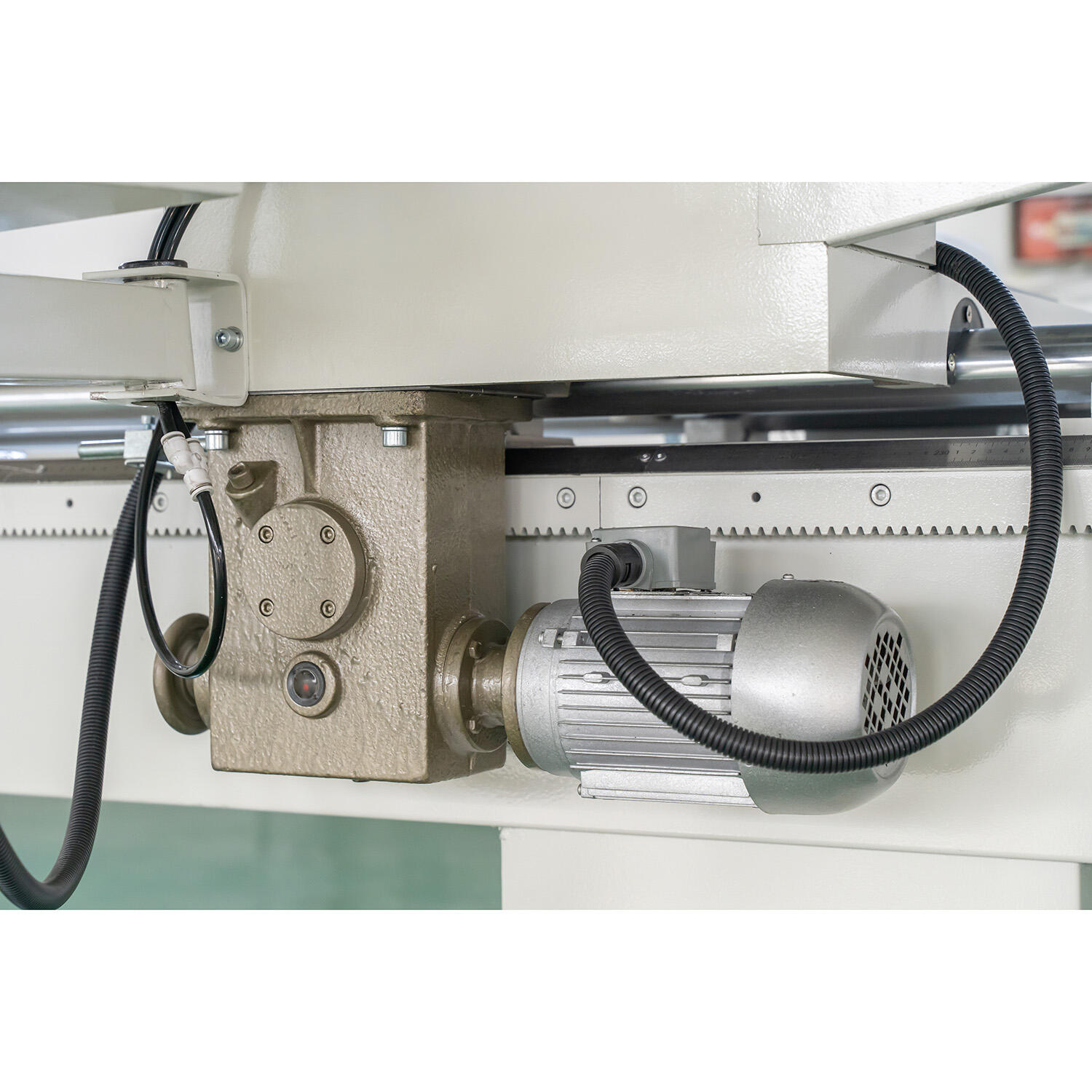
Encoder Alignment and Positional Feedback Calibration
Precise encoder alignment forms the foundation of dimensional accuracy in aluminum profile cutting saw calibration. Without proper mounting and signal validation, even minor deviations compound during high-speed operations.
Mounting Tolerance, Backlash Compensation, and Feed-Axis Closed-Loop Stability
Mounting encoders requires sticking to about 0.02 mm radial tolerance if we want to avoid positional drift while doing intense vibration cutting operations. The backlash compensation algorithms work hard to fight off any mechanical play in those feed systems, which becomes really important when dealing with aluminum since its density can vary so much from batch to batch. These days most modern saw equipment has closed loop control systems running at over 10 kHz sampling rates, constantly checking what the encoder is saying versus where it should be going. This kind of real time tweaking keeps things within plus or minus 0.05 mm repeatability even after hundreds of cycles, something absolutely necessary for aerospace extrusions where small errors just keep building up. And don't forget about the thermal sensors built right into the drive motors either. They kick in the dynamic stiffness compensation whenever temperatures around the machine change by more than 2 degrees Celsius.
Dual-Channel Quadrature Signal Validation for Real-Time Positional Integrity
Quadrature encoders produce those A/B signals with their characteristic 90 degree phase shift, which allows for really fine resolution down at the micron level and tells direction clearly without confusion. The signal checking circuits watch out for those Lissajous figures on the oscilloscope display. When they start looking elliptical instead of square, that's usually a sign something's wrong either with electromagnetic interference messing things up or maybe some damaged cables somewhere along the line. Most industrial setups have these systems constantly comparing readings from backup encoders too. If there's a mismatch bigger than five counts between them, the machine will automatically shut down as a safety measure. According to some tests published last year in Precision Engineering Journal, this kind of dual channel setup cuts down on positioning errors by around three quarters compared to older single signal approaches. What makes this particularly important is keeping everything within tight tolerances of about 0.1 mm even when working with tricky materials like aluminum that tends to gum up during machining processes.
Stop Position Calibration Using Traceable Reference Standards
NIST-Traceable Gauge Blocks and Empirical Repeatability Testing (500+ Cycles)
Getting down to sub 0.1 mm accuracy when calibrating aluminum profile cutting saws really depends on checking those stop positions against proper certified standards. The whole point of using NIST traceable gauge blocks is to create that continuous link back to international SI units. There's this thing called the 4:1 accuracy rule too, which basically means our reference tools need to be four times as precise as what we're trying to measure. So if we want to validate something with a plus or minus 0.1 mm tolerance, our standards themselves have to hit around plus or minus 0.025 mm. After setting things up right initially, most shops run these tests over 500 cutting cycles just to see where any drift might show up in the feed system or clamping mechanism. Throw in some laser interferometer checks for good measure, and we can tell if everything stays within those ISO 9001 compliance ranges. Top manufacturers are seeing about 99.8% consistent measurements once they get this process dialed in, which cuts down on all that expensive rework caused by dimension mistakes in precision work.
Thermal Compensation for Aluminum-Specific Dimensional Stability
Modeling Thermal Expansion (23.1 µm/m·°C) Within Sub-0.1 mm Tolerance Bands
The thermal expansion rate of aluminum at around 23.1 micrometers per meter per degree Celsius really calls for careful planning when trying to maintain stable dimensions during manufacturing. If we don't account for this property, just a 5 degree temperature change in a 2 meter long piece can lead to about 0.23 mm of warping along straight lines, which goes beyond what most tight tolerance specifications allow. That's where finite element analysis comes into play. This method looks at how heat spreads through different parts of the cutting area and predicts exactly where and how much expansion will happen across all three spatial directions. The best models combine real world shop floor measurements with fundamental material science principles to create adjustment formulas that keep errors below 0.1 mm. To put things in perspective, standard CNC machines usually work within plus or minus 0.05 mm tolerances for aluminum parts. So even small changes in room temperature need proper correction if manufacturers want their products to meet specification requirements consistently.
Embedded Temperature Mapping and Real-Time Offset Correction Algorithms
Resistance temperature detectors or RTDs installed on saw carriages, cutting blades, and material clamps continuously produce thermal maps at intervals of half a second. These control systems then take all that data and run it through special correction formulas which tweak the tool paths as needed. If there's any unusual heat buildup around where the cutting happens, the system quickly moves the blade position based on calculated expansion numbers. The whole feedback loop keeps things accurate to within plus or minus 0.08 millimeters even when running nonstop. This prevents those annoying little errors from adding up over time and helps maintain proper fit and finish requirements for critical parts used in both aircraft manufacturing and car production industries.
Laser Interferometry Verification of Linear Axis Accuracy
When it comes to checking the straightness of aluminum saws, laser interferometry remains the gold standard for precision work. The system works by shooting laser beams along the machine's moving parts, measuring tiny deviations down to about half a micrometer. And yes, these readings come with proper NIST traceability for quality assurance. What makes this approach special is how it captures straightness issues, positioning problems, and angle errors all at once during one setup session. This eliminates those annoying uncertainties that build up when doing multiple separate checks. The detailed map created shows up even the smallest backlashes or misalignments that regular mechanical tools would miss entirely. In aluminum cutting operations where heat causes materials to expand and contract, having this kind of baseline data allows machines to adjust on the fly. Real time corrections keep cut dimensions within strict limits, typically under 0.1 millimeter tolerance. Shops that incorporate these verification methods see noticeable improvements in their aluminum profile cutting accuracy, especially when running through large batches of material day after day.
FAQ
Why is encoder alignment important in aluminum profile cutting saw calibration?
Encoder alignment is crucial because it ensures dimensional accuracy. Without proper alignment, even small deviations can accumulate, especially during high-speed operations, leading to significant inaccuracies.
How does thermal expansion affect aluminum profile saws?
Aluminum's thermal expansion rate means that temperature changes can cause dimensional instability. This is why it's important to use thermal compensating techniques to maintain accuracy within tight tolerances.
What role do NIST-traceable gauge blocks play in calibration?
NIST-traceable gauge blocks provide a continuous link back to international SI units, ensuring precision and accuracy in calibration efforts.
What is laser interferometry used for in aluminum saw calibration?
Laser interferometry is used to verify linear axis accuracy by measuring tiny deviations and ensuring precision during aluminum profile cutting operations.